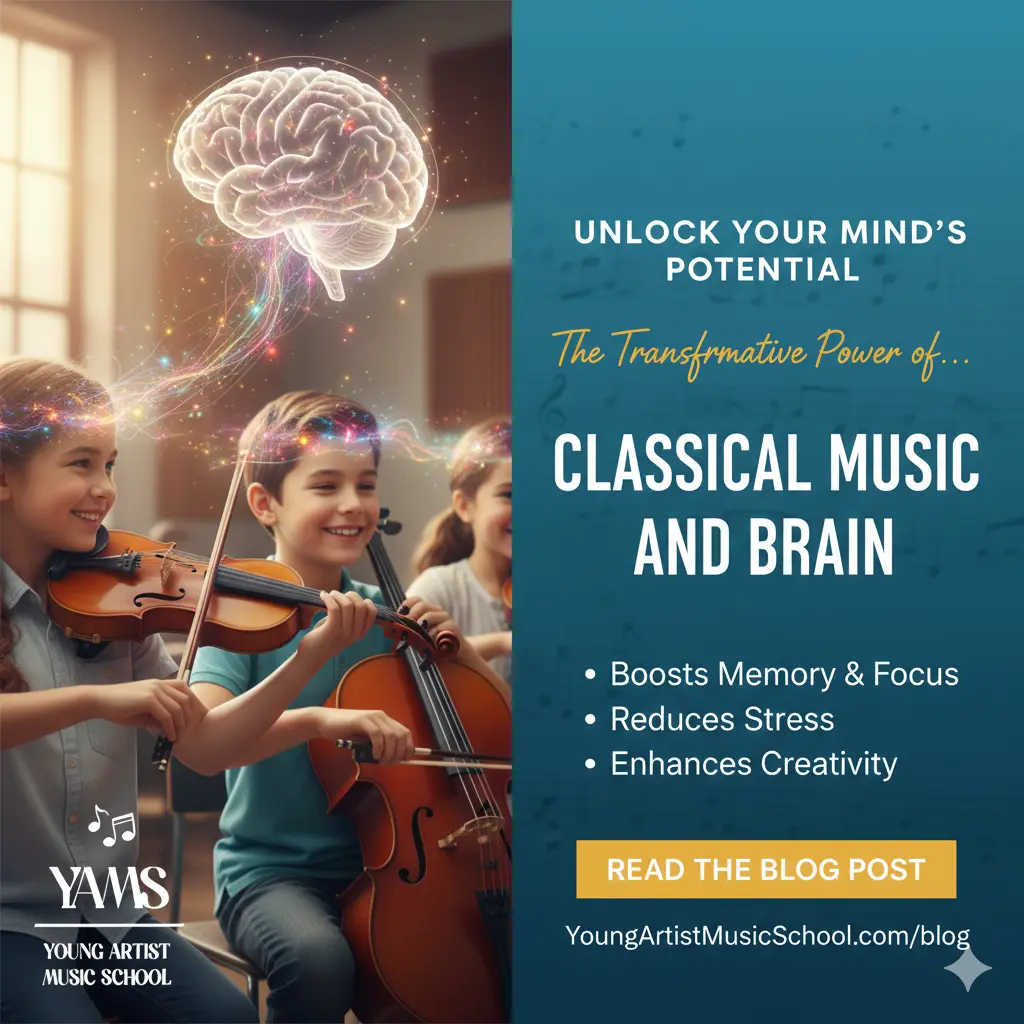
For decades, scientists have explored the link between complex melodies and human intelligence. At Young Artist Music School, we believe that understanding how classical music and brain functions interact can help students of all ages unlock their full potential. Recent neuroscientific studies from 2025 and 2026 have confirmed that this genre does more than just provide a pleasant background; it actually rewires the way we think and process information.
The Science of Neural Synchronization
The relationship between classical music and brain activity is centered on a phenomenon called “neural resonance.” Unlike simpler genres, the intricate structures found in works by Bach or Mozart force the brain to engage in deep listening. This process synchronizes brain waves across the motor and prefrontal cortex, which can improve your ability to focus and solve complex problems. When a student engages with classical music and brain training simultaneously, they are essentially giving their mind a high-intensity workout that strengthens white matter pathways.
Boosting Memory and Emotional Intelligence
Beyond simple “focus,” classical compositions are proven to stimulate the production of dopamine and serotonin. This biochemical shift reduces cortisol levels—the primary hormone responsible for stress—allowing the hippocampus to encode new memories more efficiently. For young children, this means better language acquisition and spatial reasoning. For adults, it translates to a significant reduction in mental fatigue and a higher capacity for empathy and emotional regulation.
Long-Term Benefits of Active Engagement
While listening to a concerto is beneficial, the most profound changes occur when a student learns to play an instrument. Active participation creates a “neural handshake” between the left and right hemispheres of the brain. This increased connectivity doesn’t just make you a better musician; it improves executive function, task-switching, and even mathematical ability. By making classical music a part of your daily routine, you are investing in long-term cognitive health and a sharper, more resilient mind.